

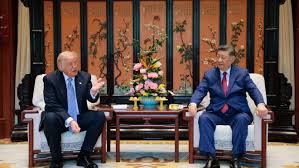
United States President Donald Trump departed China on Friday after concluding a closely watched two-day summit with Chinese President Xi Jinping in Beijing. The meeting focused on trade, the Iran conflict, Taiwan, global energy security, and the future of US-China relations.
Although Washington promoted the visit as a diplomatic success that produced major trade progress, Beijing’s official statements painted a more cautious picture. China emphasized strategic stability, warned the United States against interfering in Taiwan, and criticized the ongoing US-Israel conflict involving Iran.
While both governments released summaries of the discussions, several key differences emerged between the White House and Chinese Foreign Ministry accounts, revealing how differently the two sides interpreted the summit.
Trade Deals Dominate Trump’s Messaging
President Trump repeatedly claimed that significant trade agreements were reached during the summit. Speaking at the end of the visit, he described the negotiations as “fantastic trade deals for both countries.”
One of the most talked-about claims involved a possible aircraft agreement between China and American aviation giant Boeing. Trump told Fox News that China had agreed to purchase 200 Boeing jets, which would represent China’s first major purchase of American aircraft in nearly ten years.
However, China’s official statements did not mention the Boeing deal or any other confirmed trade agreements. Boeing itself has also not publicly confirmed the reported purchase. The uncertainty surrounding the announcement caused Boeing shares to fall by more than four percent after investors had anticipated a much larger order.
Trump’s delegation also included several prominent American business leaders, including Jensen Huang, fueling speculation about potential technology agreements. Yet no breakthrough involving advanced AI chip exports from Nvidia was announced.
China did indicate that it plans to further open its markets to American companies, but Xi Jinping did not provide details on what this would involve. Both countries agreed in principle to expand economic cooperation, increase market access, and boost Chinese purchases of US agricultural products.
Still, the absence of specific agreements in Beijing’s official statements suggests that many negotiations remain unresolved.
Different Narratives on the Fentanyl Crisis
The White House emphasized cooperation on reducing the flow of fentanyl-related chemicals into the United States. Trump has frequently accused China of contributing to America’s fentanyl crisis and previously used the issue to justify tariffs on Chinese imports.
According to the White House, both leaders discussed building on efforts to stop fentanyl precursors from reaching the US.
China’s Foreign Ministry, however, made no mention of fentanyl, drug trafficking, or narcotics cooperation in its post-summit statements. The omission highlighted another area where the priorities of the two governments differed significantly.
Iran War Discussions Reveal Sharp Differences
The conflict involving Iran became another major subject during the summit, but Washington and Beijing again described the discussions differently.
The White House stated that both countries agreed Iran should never possess nuclear weapons. China’s statements avoided directly endorsing that position. Instead, Beijing stressed that the war “should never have happened” and called for renewed dialogue and diplomatic negotiations.
China urged all parties to pursue political solutions regarding Iran’s nuclear programme and broader regional tensions. Beijing also warned about the conflict’s impact on global trade, energy supplies, and supply chains.
The Strait of Hormuz emerged as another critical topic. The White House said both sides agreed the vital shipping route must remain open to ensure the free flow of global energy supplies.
Washington also claimed Xi opposed the militarization of the strait and rejected Iran’s proposed shipping tolls. According to the White House, China expressed interest in buying more American oil to reduce dependence on Gulf shipping routes.
Yet none of these details appeared in China’s official version of events. Beijing only acknowledged that regional instability threatens the global economy and international energy markets.
Taiwan Remains a Major Flashpoint
Taiwan proved to be one of the most sensitive subjects discussed during the summit.
China’s Foreign Ministry described Taiwan as the most important issue in US-China relations. Xi Jinping warned that mishandling the Taiwan question could lead to serious confrontation and damage bilateral ties.
The White House statements notably avoided mentioning Taiwan altogether. Trump also declined to answer reporters’ questions about his position on the self-governing island during the visit.
China continues to claim Taiwan as part of its territory, while Taiwan maintains that it is a sovereign state. Although the United States officially recognizes Beijing diplomatically, Washington continues to support Taiwan under the 1979 Taiwan Relations Act by supplying weapons and expanding security cooperation.
Following China’s remarks, Taiwan’s foreign ministry defended continued US arms sales, calling them an important deterrent against regional threats.
Competing Visions for US-China Relations
China emphasized long-term strategic stability during the summit. According to Beijing, both presidents agreed to pursue a constructive relationship that could guide bilateral ties over the next three years and beyond.
The White House, meanwhile, focused more heavily on economic cooperation and commercial opportunities rather than broader geopolitical stability.
Despite their differences, both governments agreed that the talks were productive. Each side acknowledged that Trump and Xi reached several areas of common understanding and discussed major global challenges, including the Iran conflict and disruptions in the Strait of Hormuz.
FAQS
Why did Donald Trump visit China?
Donald Trump visited China to meet Chinese President Xi Jinping for discussions on trade, Iran, Taiwan, energy security, and broader US-China relations.
Did the US and China sign any trade deals?
Trump claimed several agreements were reached, including a possible Boeing aircraft deal, but China did not officially confirm any specific trade agreements.
What did China say about Taiwan?
China described Taiwan as the most important issue in US-China relations and warned that improper handling of the issue could create conflict between the two countries.
What was discussed about Iran?
Both leaders discussed the Iran conflict and concerns over the Strait of Hormuz. The US stressed preventing Iran from obtaining nuclear weapons, while China called for diplomacy and political negotiations.
Did China agree to buy Boeing aircraft?
Trump said China agreed to purchase 200 Boeing jets, but neither China nor Boeing officially confirmed the deal.
Why is the Strait of Hormuz important?
The Strait of Hormuz is one of the world’s most important oil shipping routes, carrying a significant portion of global energy supplies. Disruptions there can impact global oil and gas markets.
Conclusion
The Trump-Xi summit highlighted both cooperation and deep divisions between the world’s two largest economies. While Washington emphasized trade progress and shared positions on global security issues, Beijing focused on strategic stability, diplomacy, and protecting its core interests, particularly Taiwan.
Although both sides projected optimism publicly, the differing official statements revealed continuing mistrust and competing priorities. Trade agreements remain largely unconfirmed, disagreements over Iran and Taiwan persist, and broader geopolitical tensions continue to shape the relationship.
Even so, the summit demonstrated that both countries recognize the importance of maintaining dialogue during a period of rising global uncertainty. Whether the meeting produces lasting results or simply temporary diplomatic momentum will become clearer in the months ahead.